
Professional Integrity Training for Employees
Help employees make honest, responsible workplace choices and protect trust through consistent professional behavior.
Professional Behavior & Ethics at Work course, a 10-module online program covering integrity, accountability, confidentiality, ethical judgment, reliability and professional conduct.
One-time enrollment • Access for one employee
10 online modules • One learner account • Digital completion documentation
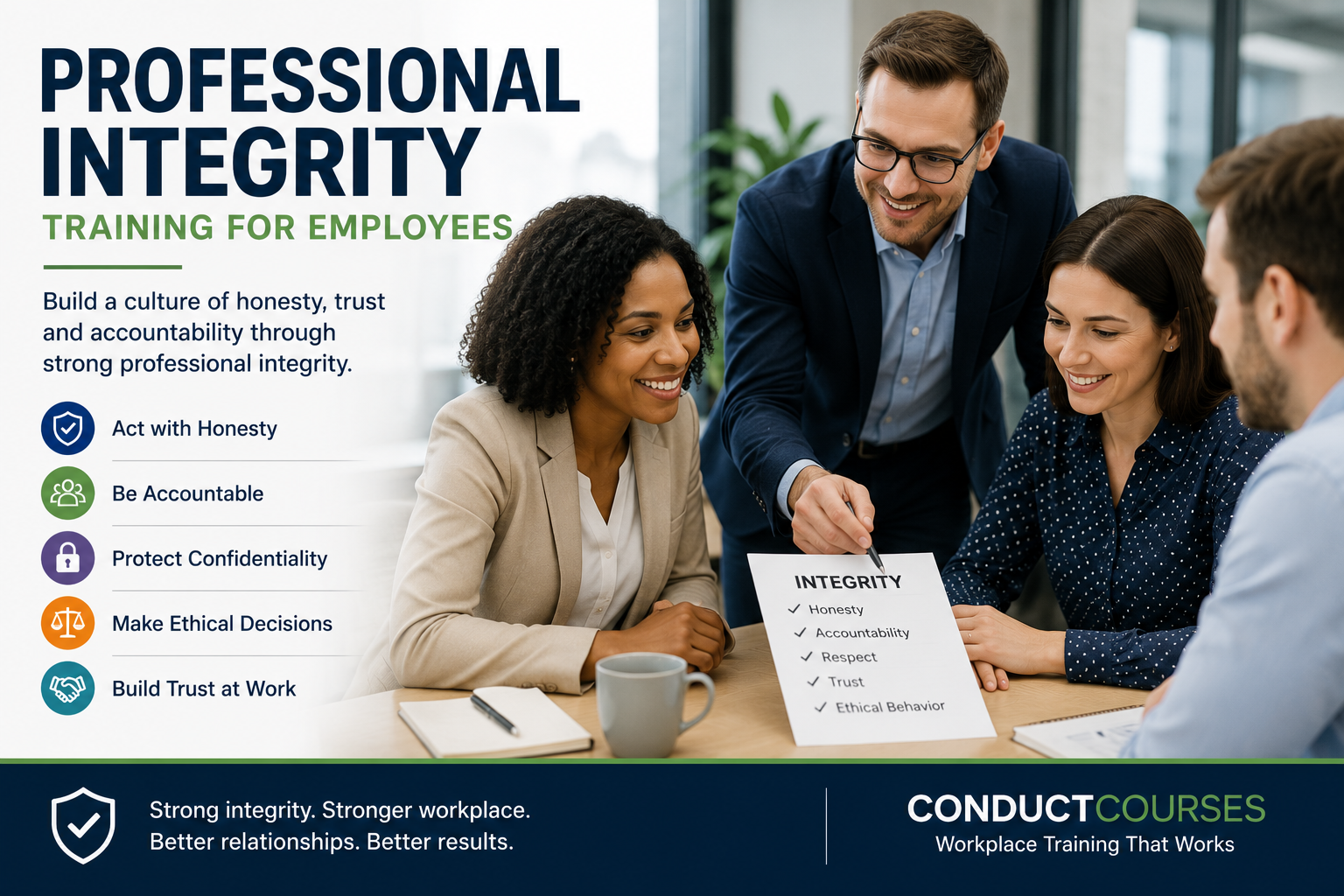
Integrity is demonstrated through consistent decisions, not just stated values.
Employees build trust when their actions match their commitments, their communication is accurate and they make responsible choices even when no one is watching.
This training helps employees connect honesty, accountability and professional judgment with everyday workplace behavior.
Common reasons employers assign this training
- Questionable judgment or inconsistent decision-making
- Failure to disclose mistakes or important information
- Confidentiality or trust concerns
- Misleading communication or incomplete reporting
- Repeated excuses, blame or lack of ownership
- Need for a stronger baseline of ethical conduct
Practical integrity skills employees can apply at work.
The course turns broad expectations such as honesty and responsibility into specific workplace behaviors.
Tell the Truth Clearly
Communicate facts accurately without hiding, exaggerating or manipulating important information.
Keep Commitments
Follow through on responsibilities or communicate early when expectations cannot be met.
Own Mistakes
Acknowledge errors, correct problems and avoid shifting responsibility to others.
Protect Confidentiality
Handle sensitive information with appropriate care, judgment and discretion.
Recognize Conflicts
Identify personal interests, pressure or divided loyalties that may affect professional judgment.
Build Trust Consistently
Use reliable, transparent behavior to strengthen professional credibility over time.
Ten modules delivered through Professional Behavior & Ethics at Work.
Professional Conduct Foundations
How integrity, judgment and reliability shape workplace trust.
Honesty in Workplace Communication
Communicating accurately without concealment, distortion or manipulation.
Consistency Between Words and Actions
Following through on commitments and professional expectations.
Confidentiality and Discretion
Protecting sensitive workplace information and appropriate boundaries.
Accountability and Ownership
Responding responsibly when mistakes, delays or problems occur.
Conflicts of Interest
Recognizing situations where personal interests may affect workplace decisions.
Pressure and Ethical Shortcuts
Identifying rationalizations that weaken professional integrity.
Professional Judgment
Choosing responsible actions when expectations or priorities compete.
Reliability and Workplace Trust
Building credibility through consistent communication and follow-through.
Applying Integrity at Work
Using a repeatable process for honest, accountable workplace decisions.
Professional-integrity enrollment provides Professional Behavior & Ethics at Work.
Professional Behavior & Ethics at Work
A 10-module online employee course covering professional conduct, integrity, accountability, confidentiality, ethical judgment and workplace trust.
- Access for one employee
- Ten structured online modules
- Practical workplace scenarios
- Digital completion documentation
View Product & Enroll
Train one employee or provide separate access across a team.
Enroll One Employee
Choose individual enrollment when one employee needs focused integrity, ethics and professional-conduct training.
- One learner account
- Ten structured online modules
- Integrity and judgment skills
- Digital completion documentation
Enroll One Employee — $349
Train Two or More Employees
Use team enrollment when multiple employees need separate accounts, progress records and completion documentation.
- Separate account for each learner
- Seat assignment and invitations
- Individual progress tracking
- Organization-level management
View Team Training Options
Choose a focused or broader workplace-development path.
Business Ethics Training
Ethical decisions, integrity, accountability and responsible workplace conduct.
View Business Ethics
Workplace Accountability Training
Ownership, reliability, communication and professional follow-through.
View Accountability
Emotional Intelligence Training
Self-awareness, professional responses, judgment and accountability.
View Emotional Intelligence
Professional integrity training questions.
What does professional integrity training for employees cover?
It covers honesty, accountability, confidentiality, conflicts of interest, ethical judgment, reliability and workplace trust.
What course appears in the employee’s learner dashboard?
The employee receives Professional Behavior & Ethics at Work. Professional Integrity Training for Employees describes the workplace need addressed by this page and is not a separate product title.
Does the $349 enrollment cover one employee?
Yes. One $349 enrollment provides access for one employee. Use team enrollment when two or more learners need separate accounts.
Can this training support coaching or an improvement plan?
Employers may use the course as one part of onboarding, coaching, professional development or a broader improvement process. It does not replace employer documentation or disciplinary procedures.
Is this course only about honesty?
No. It also addresses accountability, confidentiality, professional judgment, consistency, trust and responsible workplace behavior.
Does the course include completion documentation?
Yes. Digital completion documentation is available after the employee completes the assigned coursework.
Help one employee strengthen honesty, accountability and professional trust at work.
Enroll one employee in Professional Behavior & Ethics at Work, use team enrollment for multiple learners, or choose the Employee Conduct Program for broader development.
Conduct Courses provides workplace education and professional-development training. This course is not legal advice and does not replace employer policies, disciplinary procedures or legally required training.