
Difficult Conversations Training for Employees
Help employees prepare for sensitive workplace conversations, communicate concerns clearly and remain professional when tension rises.
Workplace Communication Skills course, covering listening, clarity, tone, feedback, conflict communication and professional workplace interactions.
One-time enrollment • Access for one employee
Online employee training • One learner account • Digital completion documentation
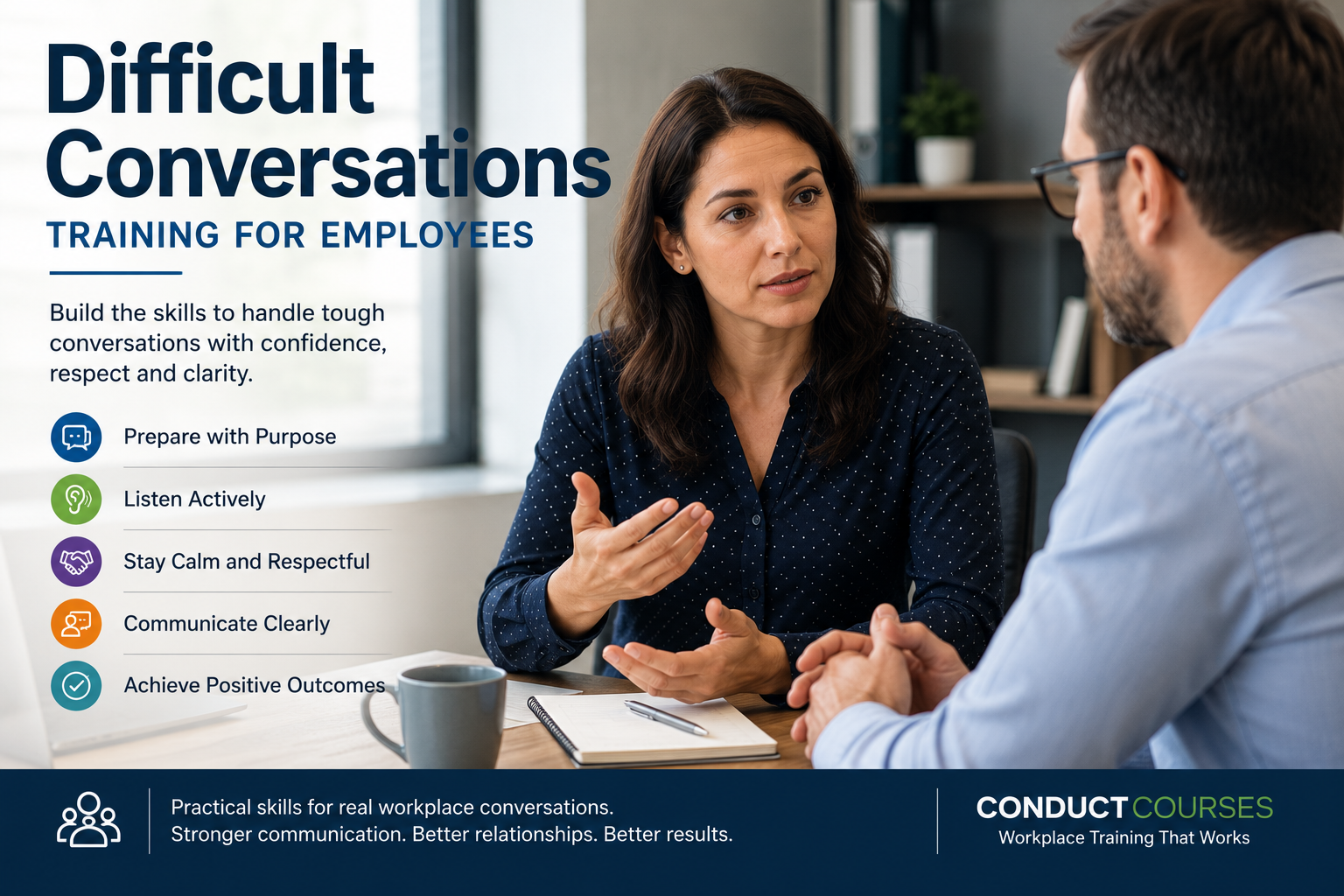
A difficult conversation becomes more manageable when employees have a clear process.
Sensitive workplace conversations often go poorly because employees enter them unprepared, speak reactively or focus on blame instead of the specific issue.
This training helps employees prepare, communicate clearly, listen carefully and end with useful next steps.
Common reasons employers assign this training
- Avoiding necessary workplace conversations
- Becoming defensive when concerns are raised
- Using vague or emotionally charged language
- Escalating disagreement instead of clarifying the issue
- Difficulty giving or receiving feedback
- Need for stronger communication during coaching
Practical skills for handling sensitive workplace conversations.
Prepare the Message
Identify the issue, desired outcome and facts that should guide the conversation.
Choose Neutral Language
Describe behavior and impact without exaggeration or personal attacks.
Listen Before Responding
Allow the other person to explain and ask clarifying questions.
Manage Defensiveness
Stay focused without becoming reactive or argumentative.
Address Disagreement
Separate facts, assumptions and emotion while working toward resolution.
Confirm Next Steps
End with clear expectations, responsibilities, timelines and follow-up.
Delivered through Workplace Communication Skills.
Preparing for the Conversation
Clarifying the concern, outcome and appropriate setting.
Facts, Assumptions and Emotion
Separating observable information from interpretation and reaction.
Professional Opening Statements
Starting directly and respectfully without creating unnecessary defensiveness.
Active Listening and Clarifying
Understanding the other person before proposing a solution.
Tone, Timing and Word Choice
Using communication habits that keep the discussion professional.
Giving and Receiving Feedback
Discussing concerns with specificity and responding constructively.
Managing Tension
Pausing, redirecting and lowering emotional intensity.
Handling Disagreement
Identifying shared goals and practical options.
Documenting Agreements
Confirming responsibilities, deadlines and follow-up.
Applying the Process
Using a repeatable prepare, discuss, listen and confirm framework.
Difficult-conversations enrollment provides Workplace Communication Skills.
Workplace Communication Skills
An online employee course covering listening, clarity, tone, feedback, conflict communication and professional workplace interactions.
View Product & EnrollChoose a focused or broader communication path.
Workplace Communication Skills
Clear writing, tone, listening, feedback and conflict communication.
View Communication Training
Active Listening Skills
Attention, clarifying questions and workplace understanding.
View Active Listening
Conflict Resolution Training
De-escalation, disagreement and calm professional resolution.
View Conflict Resolution
Difficult conversations training questions.
What does this training cover?
Preparation, neutral language, active listening, feedback, defensiveness, disagreement, de-escalation and next steps.
What course appears in the dashboard?
The employee receives Workplace Communication Skills. Difficult Conversations Training for Employees is the search-focused landing-page title.
Does the $349 enrollment cover one employee?
Yes. Use team enrollment when two or more learners need separate accounts.
Can this help with performance or behavior conversations?
It can help employees prepare, communicate concerns clearly, listen to feedback and confirm expectations. It does not replace a formal disciplinary process.
Can employers use this for coaching?
Yes. It may support onboarding, communication coaching or professional development.
Is completion documentation included?
Yes. Digital completion documentation is available after the coursework is completed.
Help employees handle sensitive workplace conversations with greater clarity and professionalism.
Enroll one employee in Workplace Communication Skills, use team enrollment for multiple learners, or choose the Employee Conduct Program for broader development.