Teamwork & Collaboration Training for Employees
Help employees communicate more clearly, contribute more reliably and work more effectively with coworkers across everyday workplace tasks.
This search-focused landing page is fulfilled through your existing Workplace Communication Skills course, an online employee course covering listening, clarity, tone, feedback, conflict communication and professional workplace interactions.
One-time enrollment • Access for one employee
Online employee training • One learner account • Digital completion documentation
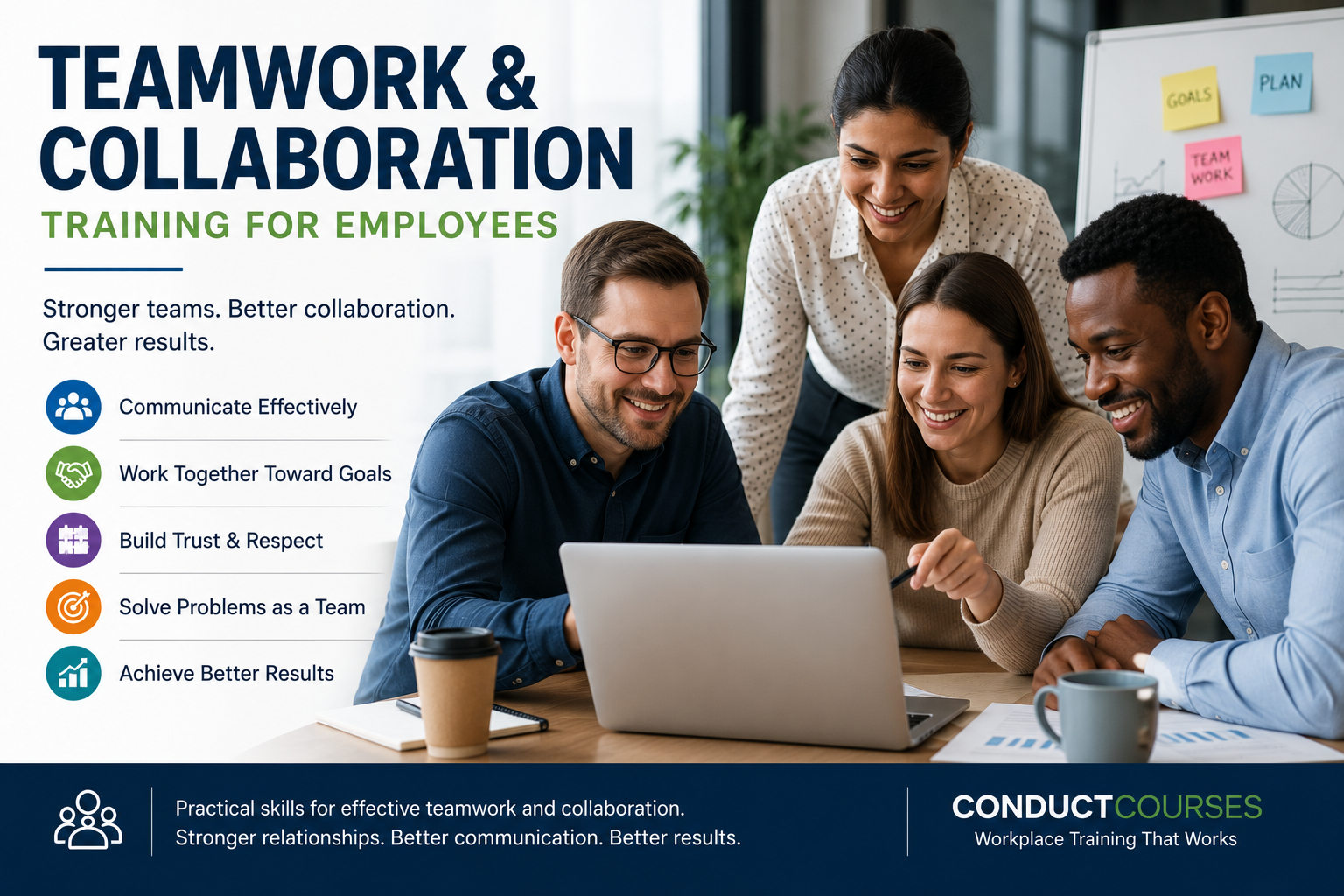
Effective teamwork depends on clear communication, shared responsibility and reliable follow-through.
Teams struggle when employees make assumptions, fail to communicate progress or treat collaboration as someone else’s responsibility.
This training helps employees contribute more consistently, listen to coworkers and keep shared work moving forward.
Common reasons employers assign this training
- Poor communication across shared tasks
- Unclear roles, responsibilities or expectations
- Missed handoffs, updates or deadlines
- Difficulty accepting input from coworkers
- Repeated tension during group work
- Need for stronger collaboration and team accountability
Practical teamwork and collaboration skills employees can use immediately.
The course focuses on observable communication and coordination habits that support stronger teams.
Clarify Roles
Confirm who is responsible for each task, decision, deadline and handoff.
Share Information
Provide timely updates so coworkers can make informed decisions and avoid delays.
Listen to Coworkers
Consider different perspectives before responding or deciding how work should proceed.
Handle Disagreement
Discuss competing ideas without turning the issue into a personal conflict.
Follow Through
Complete commitments and communicate early when an obstacle affects the team.
Support Shared Goals
Balance individual priorities with the team’s responsibilities, deadlines and outcomes.
Teamwork and collaboration delivered through Workplace Communication Skills.
Foundations of Team Communication
How clarity, listening and expectations influence group performance.
Roles and Shared Responsibility
Confirming ownership without creating duplication, confusion or gaps.
Active Listening in Teams
Understanding coworker perspectives before proposing a decision or response.
Updates, Handoffs and Follow-Through
Communicating progress, obstacles and next steps across shared work.
Giving and Receiving Input
Sharing ideas professionally and responding constructively to coworker feedback.
Managing Team Disagreement
Keeping the focus on the issue, the work and the shared outcome.
Professional Tone and Respect
Using language and behavior that support productive working relationships.
Remote and Digital Collaboration
Improving clarity and coordination in chat, email and virtual meetings.
Team Accountability
Taking ownership without blaming coworkers when plans change or mistakes occur.
Applying Collaboration Skills
Using a repeatable process to clarify, communicate, coordinate and follow through.
Teamwork-and-collaboration enrollment provides Workplace Communication Skills.
Workplace Communication Skills
An online employee course covering listening, clarity, tone, feedback, conflict communication and professional workplace interactions.
- Access for one employee
- Practical workplace examples
- Team communication and collaboration
- Digital completion documentation
View Product & Enroll
Train one employee or provide separate access across a team.
Enroll One Employee
Choose individual enrollment when one employee needs focused teamwork, communication and collaboration training.
- One learner account
- Listening and communication skills
- Teamwork and coordination habits
- Digital completion documentation
Enroll One Employee — $349
Train Two or More Employees
Use team enrollment when multiple employees need separate accounts, progress records and completion documentation.
- Separate account for each learner
- Seat assignment and invitations
- Individual progress tracking
- Organization-level management
View Team Training Options
Choose a focused or broader communication path.
Workplace Communication Skills
Clear writing, professional tone, listening, feedback and conflict communication.
View Communication Training
Active Listening Skills
Attention, clarifying questions, reflective listening and workplace understanding.
View Active Listening
Difficult Conversations Training
Preparation, feedback, disagreement and professional workplace communication.
View Difficult Conversations
Teamwork and collaboration training questions.
What does teamwork and collaboration training for employees cover?
It covers team communication, shared responsibility, active listening, coordination, follow-through, feedback, disagreement and professional working relationships.
What course appears in the employee’s learner dashboard?
The employee receives Workplace Communication Skills. Teamwork & Collaboration Training for Employees describes the workplace need addressed by this page and is not a separate product title.
Does the $349 enrollment cover one employee?
Yes. One $349 enrollment provides access for one employee. Use team enrollment when two or more learners need separate accounts.
Can this help employees who struggle with group work?
Yes. The training addresses roles, communication, listening, handoffs, disagreement and follow-through across shared tasks.
Can employers use this for onboarding or team development?
Employers may use the course as one part of onboarding, communication development, team-building or a broader improvement process.
Does the course include completion documentation?
Yes. Digital completion documentation is available after the employee completes the assigned coursework.
Help employees communicate, coordinate and collaborate more effectively at work.
Enroll one employee in Workplace Communication Skills, use team enrollment for multiple learners, or choose the Employee Conduct Program for broader development.
Conduct Courses provides workplace education and professional-development training. This course does not replace employer policies, disciplinary procedures or legally required training.